Japan’s Tanabata Festival: A Festival of Wishes and Romance
Every summer, streets, shopping arcades, and temples across Japan come alive with colorful decorations, bamboo branches, and the hopes of thousands during 七夕 Tanabata, or 星祭り Hoshimatsuri Star Festival. Most regions of Japan celebrate Tanabata on July 7th, though some places follow the lunar calendar and celebrate it in August. No matter when it falls, Tanabata is a beloved festival that blends ancient legend, poetry, and community celebration.

Origins and History of Japan’s Tanabata
The origins of Tanabata can be traced back over 1,300 years to China’s Qixi Festival (七夕節), which came to Japan during the Nara period (710–794). The festival centers on the romantic folktale of two celestial lovers: 織姫 Orihime, the weaving princess represented by the star Vega, and 彦星 Hikoboshi, the cowherd represented by the star Altair. According to legend, these two were separated by the 天の川 Amanogawa (the Milky Way) as punishment for neglecting their duties after falling in love. They are able to meet just once a year, on the seventh day of the seventh lunar month, if the skies are clear.
The story resonated deeply with Japanese culture. It merged with local traditions like rice planting and weaving. Eventually it evolved into the Tanabata we know today.
How Tanabata is Celebrated
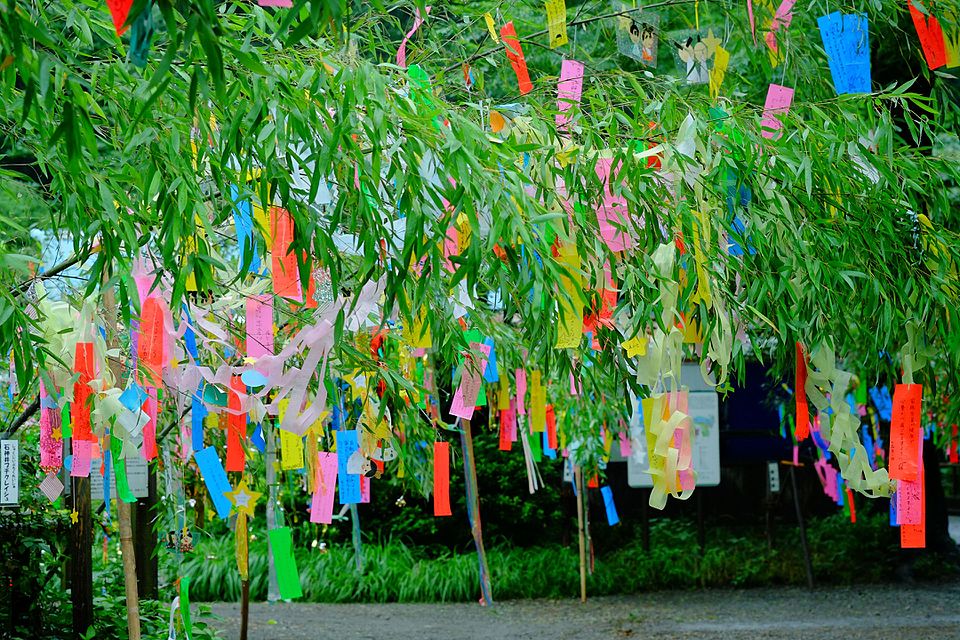
A hallmark of Japan’s Tanabata Festival is the custom of writing wishes on small, colorful strips of paper called 短冊 tanzaku. People then hang these on 笹 sasa, slender bamboo branches. These wishes range from personal dreams and romantic hopes to aspirations for good health, success, or world peace. Schools, shopping malls, and homes often display elaborately decorated bamboo trees filled with these wishes.
Besides tanzaku, people also adorn the branches with other paper ornaments symbolizing good fortune — such as 折鶴 orizuru (paper cranes) for longevity and 投網 toami (nets) for good harvests. In places like 仙台 Sendai, which hosts one of the largest Tanabata festivals in August, massive streamers, intricate paper crafts, and parades fill the streets.
Children enjoy festival games like 金魚すくい kingyo sukui (goldfish scooping), or they try their luck at catching prizes. The sounds of 太鼓 taiko drums and festival music add to the lively atmosphere. So do vibrant 浴衣 yukata, the lightweight summer kimono often worn during the celebrations.
Foods and Traditions of Japan’s Tanabata Festival
While Tanabata does not have as many signature foods as some other Japanese festivals, people often enjoy traditional summer treats while attending festivities. Popular street foods include たこ焼き takoyaki (octopus balls), 焼きそば yakisoba (fried noodles), and かき氷kakigōri (shaved ice flavored with syrup), perfect for beating the summer heat. In some regions, people eat そうめん sōmen, thin wheat noodles said to resemble the threads Orihime weaves.
Tanabata Today: Popularity and Significance
In modern Japan, Tanabata remains a cherished summer event, although its significance varies by region. Major cities like 仙台 Sendai and 平塚 Hiratsuka host grand festivals that attract tourists from across the country and abroad. These celebrations serve as major cultural events, boosting local economies and preserving community traditions. Elsewhere, Tanabata may be a quieter affair, marked primarily by decorations in schools, shops, and homes.
Despite its ancient roots, Tanabata continues to inspire people to reflect on their hopes and dreams. The sight of thousands of wishes swaying gently on bamboo branches under the night sky remains a moving symbol of human longing and connection.
If you visit Japan during Tanabata, don’t miss the chance to write your own wish and join in this beautiful celebration of love, hope, and the stars. 七夕おめでとう Tanabata omedetō — Happy Tanabata!

Get on the road to speaking Japanese with the Language Garage!
We hope you’ve enjoyed learning about Japan’s Tanabata Festival. If you’d like to learn more:
- Follow us on Facebook, LinkedIn, BlueSky, Twitter, Threads, Mastodon, Instagram, or Pinterest. We publish lots of Japanese vocabulary, grammar, and culture notes, so it’s a great way to pick up some new vocabulary and practice.
- Check out our other posts on Japanese language, culture, and more.
- Enroll in affordable, flexible, and personalized private online Japanese lessons or sign up for a small group online Japanese class.
- Create a free Language Garage account to access tons of Japanese vocabulary, grammar, and culture.
Image Source: Wikimedia Commons