Korea’s Boryeong Mud Festival: The Country’s Dirtiest and Most Joyful Summer Celebration
Every summer, the quiet coastal city of 보령 Boryeong on South Korea’s west coast transforms into a muddy playground of laughter, music, and youthful energy. The 보령머드축제 Bolyeong Meodeu Chugje (Boryeong Mud Festival) is one of Korea’s most unique and internationally famous festivals. It attracts millions of visitors from around the world. Traditional Korean holidays have their roots in Confucian family values or ancient rituals, The Mud Festival on the other hand is a relatively new celebration focused on fun, wellness, and global community.
Origins and History of Korea’s Boryeong Mud Festival
The festival began in 1998 as a creative marketing campaign to promote the region’s rich mud deposits. The source is the extensive 갯벌 gaetbeol (tidal mudflats) near the city. This mud is famous for its high mineral content and beneficial effects on the skin. Local cosmetic companies had started using 보령머드 Bolyeong Meodeu (Boryeong mud) in skincare products. Soon organizers realized they could showcase these benefits in a more engaging way. Thus, the Boryeong Mud Festival was born, turning the city into a giant spa and mud arena for several days each July.
Originally modest in scale, the event quickly grew in popularity thanks to international media attention and word-of-mouth. Now, the festival draws over 1.5 million visitors annually. This includes tourists from across Asia, Europe, and North America.
How People Celebrate Korea’s Boryeong Mud Festival Today
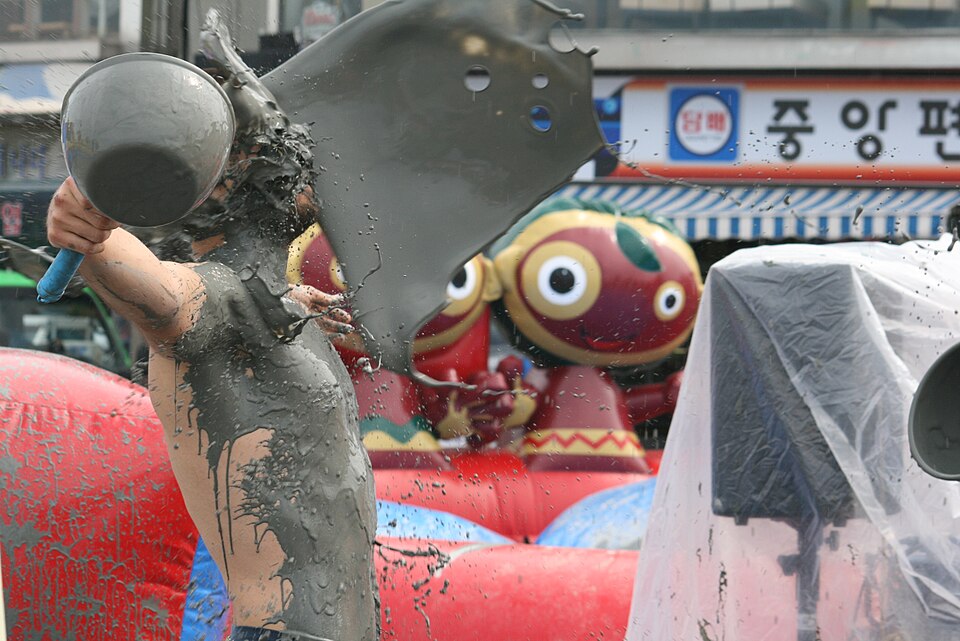
The festival typically runs for about two weeks in mid-July. Its center is 대천해수욕장 Daecheon Haesuyogjang (Daecheon Beach). The highlight is a massive mud zone near the beach, where attendees can splash, slide, and roll in mud to their heart’s content. Events include 씨름 meodeu ssileum (mud wrestling), sliding in mud, running obstacle courses, mud painting and mud massage zones. There are also live K-pop concerts and dance parties at night, and 불꽃놀이 bulkkotnori (fireworks) and beach games. Participants often wear swimsuits or matching team shirts, and they rarely stay very clean. 재미있어요! jaemi isseoyo! It’s fun!
If rolling around in mud isn’t quite your thing, there’s also a more relaxed side to the festival. You can enjoy 머드팩 meodeupaeg (mudpack facials) or shop for cosmetics using Boryeong mud.
Food vendors line the beach promenade with typical summer favorites. These may include 호떡 hotteok (sweet pancakes filled with sugar and nuts), 튀김 twigim (deep-fried snacks); and 해물파전 haemul pajeon (savory seafood pancakes). You’ll also find plenty of 막걸리 makgeolli—a traditional Korean rice wine—served in plastic cups to wash down the excitement.
Cultural Context and Significance of Korea’s Boryeong Mud Festival
Unlike traditional Korean holidays such as 추석 Chuseok or 설날 Seollal, which emphasize family, ancestors, and national heritage, the Boryeong Mud Festival is a modern, secular event with a playful, global spirit. Participation cuts across age and nationality, though it skews younger, especially among college students and tourists in their 20s and 30s.
Still, the festival is a point of pride for locals and plays a significant role in regional tourism. It showcases a lighter side of Korean culture—one that values wellness, outdoor fun, and communal joy. In this way, the Mud Festival serves as a counterpart to more reflective or ritual-based holidays.
If you ever visit Korea during the Mud Festival, you can try sliding head-first into a mud pit or relaxing with a mineral-rich mud facial while watching the waves roll in. No matter what you do, the Boryeong Mud Festival offers a truly unforgettable experience. It’s not just about getting dirty—it’s about letting go, connecting with people from around the world, and celebrating summer in the most joyous (and muddy) way possible.

Get on the road to speaking Korean with the Language Garage!
We hope you’ve enjoyed learning about Korea’s Boryeong Mud Festival. If you’d like to learn more:
- Follow us on Facebook, LinkedIn, BlueSky, Twitter, Threads, Mastodon, Instagram, or Pinterest. We publish lots of Korean vocabulary, grammar, and culture notes, so it’s a great way to pick up some new vocabulary and practice.
- Check out our other posts on Korean language, culture, and more.
- Enroll in affordable, flexible, and personalized private online Korean lessons or sign up for a small group online Korean class.
- Create a free Language Garage account to access tons of Korean vocabulary, grammar, and culture.
Image Source Wikimedia Commons