China’s Hungry Ghost Festival: Tradition, Ritual, and Modern Meaning
The Hungry Ghost Festival, known in Chinese as 中元节 Zhōngyuán Jié (Mid-Yuan Festival), is one of the most important festivals in the traditional lunar calendar. It takes place on the fifteenth night of the seventh lunar month, sometimes referred to as 鬼月 Guǐ Yuè (Ghost Month). This typically falls in August or September. According to ancient beliefs from 道教 Dàojiào (Daoism) and 佛教 Fójiào (Buddhism), the gates of the underworld open during this time. Spirits of the deceased—especially restless or “hungry” ghosts without descendants to honor them—are allowed to roam the human world.
The festival has deep historical roots. In Daoist tradition, it is linked to ceremonies for 地官大帝 Dìguān Dàdì (Emperor of Earth), who pardons sins on this day. In Buddhism, the festival corresponds to 盂兰盆节 Yúlánpén Jié (Ullambana Festival). This festival commemorates the monk 目连 Mùlián (Maudgalyāyana), who saved his mother’s soul from torment by offering food and prayers. Over time, these traditions merged, creating the cultural and religious observance we know today.
Customs and Celebrations of China’s Hungry Ghost Festival
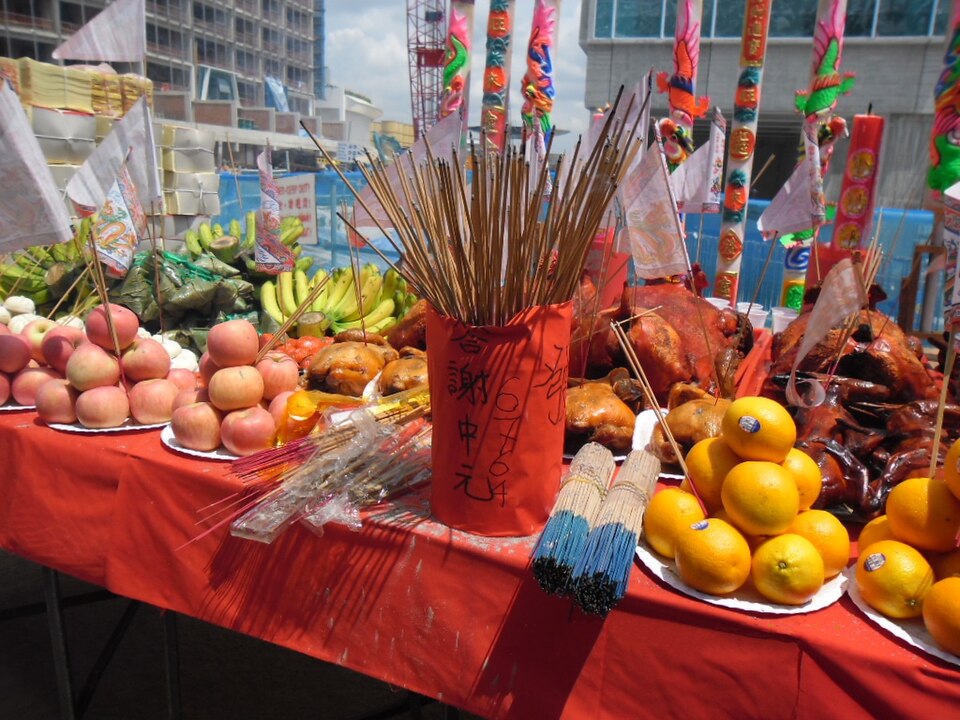
During 中元节 Zhōngyuán Jié, families perform rituals to honor both their ancestors and wandering spirits. One of the most iconic practices is burning 纸钱 zhǐqián (spirit money) or 冥币 míngbì (hell bank notes) so that the dead may use it in the afterlife. People also prepare 供品 gòngpǐn (offerings) such as 水果 shuǐguǒ (fruit), 米饭 mǐfàn (rice), 肉类 ròulèi (meat), and even symbolic 酒 jiǔ (alcohol).
Another striking custom is the burning of 纸扎 zhǐzhā (paper effigies). These can include not just clothes and houses, but even modern luxuries like paper cars, cell phones, or computers. This reflects a blend of ancient ritual with contemporary life.
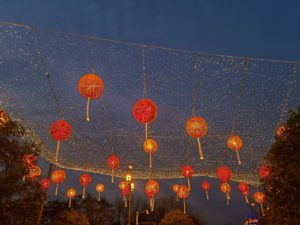
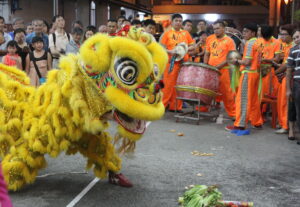
In many communities, people set out 长桌宴 chángzhuō yàn (long table banquets) on the streets with food for wandering ghosts. People release lanterns called 河灯 hédēng (river lanterns) on rivers to guide lost spirits back to the underworld. The festival also features 戏曲表演 xìqǔ biǎoyǎn, (opera performances) and 歌舞 gēwǔ (song and dance) staged outdoors. Often the first row of seats remains empty for unseen guests.
Because of its spiritual associations, there are also many taboos during Ghost Month. Superstitious people avoid swimming (for fear of being pulled under by spirits), moving house, or starting new businesses.
Food Traditions of China’s Hungry Ghost Festival
Food plays a central role in 中元节 Zhōngyuán Jié observances. Families prepare favorite dishes of their ancestors, along with ritual foods like 馒头 mántou (steamed buns) and 包子 bāozi (stuffed buns). In southern China, offerings may include 烧肉 shāoròu (roast pork) and 鱼 yú (fish), symbols of prosperity. Sweet cakes like 发糕 fāgāo (prosperity cake) are also popular. Family members share these foods after the offerings, emphasizing the theme of community between the living and the dead.
Modern Significance
Today, China’s Hungry Ghost Festival remains widely observed in mainland China, Taiwan, Hong Kong, and Southeast Asian Chinese communities in Singapore and Malaysia. Its significance is both religious and cultural. For the devout, it is a deeply spiritual time of 祭祀 jìsì (ancestor veneration). For others, it is more of a cultural tradition, a way of maintaining continuity with family heritage.
In modern urban China, some younger people treat it as a folk custom rather than a strict religious event. Yet even secular households may perform rituals such as burning 纸钱 zhǐqián and offering food. These are acts of 孝顺 xiàoshùn (filial piety), an enduring core value of Chinese culture.
At the same time, the festival has taken on a festive atmosphere in many places. Public performances, community banquets, and lantern displays give it a social and cultural dimension that transcends religion. It is not a public holiday in mainland China, but many local communities still treat it as an important seasonal event.
China’s Hungry Ghost Festival, 中元节 Zhōngyuán Jié, is a fascinating blend of Daoist, Buddhist, and folk traditions. It reminds people of the thin boundary between the living and the dead, and of the responsibilities of the living to care for their ancestors and community. Whether observed as a religious ritual or a cultural tradition, the festival continues to express values of remembrance, respect, and shared identity in modern Chinese society.
Get on the road to speaking Chinese with the Language Garage!
We hope you’ve enjoyed learning about China’s Hungry Ghost Festival. If you’d like to learn more:
- Follow us on Facebook, LinkedIn, BlueSky, Twitter, Threads, Mastodon, Instagram, or Pinterest. We publish lots of Chinese vocabulary, grammar, and culture notes, so it’s a great way to pick up some new vocabulary and practice.
- Check out our other posts on Chinese language, culture, and more.
- Enroll in affordable, flexible, and personalized private online Chinese lessons or sign up for a small group online Chinese class.
- Create a free Language Garage account to access tons of Chinese vocabulary, grammar, and culture.
Image Source Wikimedia Commons