China’s Qixi Festival: Celebrating Romantic Day of Legends
The 七夕节 Qīxì Jié (Qixi Festival), often called “Chinese Valentine’s Day,” is one of China’s most beloved traditional festivals. People celebrate it on the seventh day of the seventh month in the lunar calendar, which usually falls in August. Rooted in a romantic legend of love, longing, and reunion, the festival blends ancient mythology, folk customs, and modern romance.
Origins and History of China’s Qixi Festival
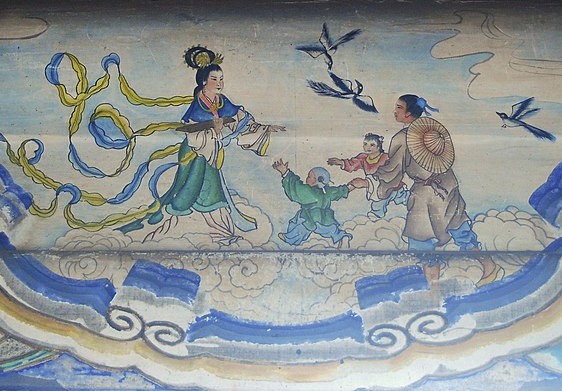
The Qixi Festival dates back more than 2,000 years to the Han Dynasty. Its story comes from the tale of the 牛郎 Niúláng (Cowherd, represented by the star Altair) and the 织女 Zhīnǚ (Weaver Girl, represented by the star Vega), a celestial maiden who wove beautiful clouds. According to legend, 牛郎 Niúláng and 织女 Zhīnǚ fell in love and married, but the 王母娘娘 Wángmǔ Niángniáng (Queen Mother of Heaven) disapproved. She separated them by creating the 银河 Yínhé (Milky Way) and allowed them to meet only once a year on the seventh night of the seventh lunar month. On this date, a bridge of 喜鹊 xǐquè (magpies) forms across the sky, joining the two lovers.
In ancient times, Qixi was especially important for young women. It was known as 乞巧节 Qǐqiǎo Jié (Festival to Beg for Skills). Traditionally, girls would pray to 织女 Zhīnǚ for 巧 qiǎo (skillfulness) in weaving, embroidery, and domestic arts. They made offerings of seasonal fruits, flowers, and tea under the moonlight. Girls would also compete in threading needles under dim light to show their dexterity.
Qixi Celebrations Today
Although China’s Qixi Festival has evolved over centuries, certain customs remain linked to its romantic and craft-centered origins. Traditional activities include:
- 拜织女 bài Zhīnǚ (paying homage to the Weaver Girl): Setting up altars with fruit, flowers, 茶 chá (tea), and 巧果 qiǎo guǒ (traditional fried pastries, more below) to pray for love and talent.
- 穿针乞巧 chuān zhēn qǐqiǎo (threading needles for skill): A test of fine motor skills, still done symbolically today.
- 观星 guān xīng (stargazing): Couples look to the stars, finding 牛郎星 Niúláng xīng) (Altair) and 织女星 (Zhīnǚ xīng) (Vega) on opposite sides of the Milky Way.
巧果 qiǎo guǒ or 乞巧果子 qǐ qiǎo guǒzi are a signature food of the Qixi festival. They are crispy fried pastries, sometimes sweetened with honey, in a variety of intricate shapes. They are both an offering to the Weaver Girl and a festive treat. Literally, 乞巧 qǐ qiǎo means begging for cleverness, a reference to the tradition of the festival. And 巧 qiǎo (skill, cleverness) is a homophone of 桥 qiáo (bridge), so the snacks have a link to the magpie bridge of legend. Other foods you might find in relation to Qixi are 花馍 huā mó (flower-shaped steamed buns) or 汤圆tāngyuán (glutinous rice balls).
Unlike major holidays like 春节 Chūnjié (Spring Festival), Qixi is not a public holiday in mainland China, so there are no official days off. However, it is widely celebrated in cities and rural areas alike, and in recent decades it has taken on a more commercial, gift-giving tone.
Qixi in Modern China
Today, Qixi is a mix of tradition and modern romance. For many couples, it is an occasion for 送礼物 sòng lǐwù (gift-giving), such as flowers, chocolates, and jewelry. Restaurants and shopping centers hold special promotions, and social media fills with romantic posts tagged 七夕快乐 Qīxì kuàilè (Happy Qixi!).
While much of its modern popularity resembles Western Valentine’s Day, the festival still retains cultural and historical importance. Rural communities may continue traditional rituals like needle-threading and weaving displays. Cultural programs on television revisit the 牛郎 Niúláng and 织女 Zhīnǚ legend, and schools may host storytelling sessions to teach children about the festival’s origins.
Cultural Significance of China’s Qixi
Qixi is more than just a day for couples—it’s a living reminder of how myth, craft, and seasonal celebration blend in Chinese tradition. It reflects values of loyalty, perseverance, and the artistry of daily life. Qixi celebrations keep alive a story that has inspired poetry, songs, and art for centuries. So, when the seventh night of the seventh lunar month comes around, remember the lovers on opposite sides of the 银河 Yínhé, and wish your friends and loved ones: 七夕快乐! Qīxì kuàilè! (Happy Qixi!).
Get on the road to speaking Chinese with the Language Garage!
We hope you’ve enjoyed learning about China’s Qixi Festival. If you’d like to learn more:
- Follow us on Facebook, LinkedIn, BlueSky, Twitter, Threads, Mastodon, Instagram, or Pinterest. We publish lots of Chinese vocabulary, grammar, and culture notes, so it’s a great way to pick up some new vocabulary and practice.
- Check out our other posts on Chinese language, culture, and more.
- Enroll in affordable, flexible, and personalized private online Chinese lessons or sign up for a small group online Chinese class.
- Create a free Language Garage account to access tons of Chinese vocabulary, grammar, and culture.