Mi piace cucinare. I like to cook. Vocabulary for Cooking in Italian
In this post we’ll look at vocabulary and expressions related to cooking in Italian. First, we’ll start with some expressions you can use to say that you’re hungry or thirsty. Then we’ll move on to Italian vocabulary for meals. After that we’ll turn to vocabulary for cooking supplies and instruments. Finally, we’ll wrap up with specific vocabulary for different ways of cooking different in Italian.
Ho fame! I’m hungry!
Let’s start with things you might want to say before you have something to eat or drink.
- Ho fame.
I’m hungry. - Sto morendo di fame!
I’m starving! (“I’m dying of hunger.”) - Ho sete.
I’m thirsty. - Sto morendo di sete!
I’m dying of thirst! (“I’m dying of thirst.”) - Voglio qualcosa da mangiare.
I want something to eat. - Voglio qualcosa da bere.
I want something to drink. - Ho bisogno di una merenda.
I need a snack.
La cena è pronta! Dinner is ready!
The meals in Italian are la colazione (breakfast), il pranzo (lunch), and la cena (dinner). A snack is una merenda.
- Cosa c’è per colazione?
What’s for breakfast? - Cosa c’è per pranzo?
What’s for lunch? - Cosa c’è per cena?
What’s for dinner? - Cosa c’è per dolce?
What’s for dessert? - Ho fatto colazione presto.
I had breakfast early. - Ho pranzato con i colleghi.
I had lunch with colleagues. - Ho cenato con la mia famiglia.
I had dinner with my family.
Il Tagliere e il contenitore Cutting boards and Mixing Bowls
When you think of vocabulary for talking about cooking in Italian, you probably think about these:: un tagliere a cutting board, un set di coltelli a set of knives, un contenitore a mixing bowl, una insalatiera a salad bowl, un cucchiaio di legno a wooden spoon, un mestolo a ladle, un robot da cucina a food processor, un frullatore elettrico an electric mixer, un wok a wok, una teglia a baking sheet/pan, una padella a frying pan, una pentola a pot.
- Ho tagliato le verdure su un tagliere.
I cut vegetables on a cutting board. - Non c’è spazio sul piano cucina.
There’s no space on the counter. - Hai un set di coltelli affilati?
Do you have a set of sharp knives? - Mescolo gli ingredienti in un contenitore.
I mix ingredients in a mixing bowl. - Mescolo la zuppa con un cucchiaio di legno.
I stir soup with a wooden spoon. - Uso un mestolo per servire la zuppa.
I use a ladle to serve soup. - I robot da cucina sono veloci e utili.
Food processors are fast and convenient. - Usi spesso il frullatore elettrico?
Do you use the electric mixer often? - I biscotti sono sulla teglia.
The cookies are on the baking sheet. - Cucino il pesce in una teglia.
I cook fish in a baking pan. - Uso molto spesso il wok.
I use the wok very often. - Cucino le uova in una padella.
I cook eggs in a frying pan. - Hai una pentola capiente per la zuppa?
Do you have a large pot for the soup?
Gli elettrodomestici Kitchen Appliances
To continue our vocabulary for cooking in Italian, let’s turn to some cooking appliances and kitchen gadets. Even if you don’t have a lot of gadgets in your kitchen, you’ve probably got most of these: un frigorifero a refrigerator, una cucina/un fornello a stove/cooker, un forno an oven, un forno a microonde a microwave oven, un tostapane a toaster, un lavandino a sink, una lavastoviglie a dishwasher.
If you like to take cooking to the next level, you may have: il cuociriso a rice maker, la macchinetta del caffè (la caffettiera) a coffee maker, il bollitore elettrico an electric kettle, la pentola a cottura lenta a slow cooker, la friggitrice ad aria an air fryer, la macchina del pane a bread machine, la gelatiera an ice-cream maker, la friggitrice a deep fryer.
- Cucino la zuppa sulla cucina.
I cook soup on the stove. - Faccio torte e pane nel forno.
I bake cakes and bread in the oven. - Riscaldo gli avanzi nel microonde.
I reheat leftovers in the microwave. - Faccio i toast nel tostapane.
I make toast in the toaster. - Uso sempre il cuociriso. Non cucino mai il riso sui fornelli.
I always use a rice cooker. I never cook rice on the stove. - Abbiamo bisogno di una nuova caffettiera.
We need a new coffee maker. - Faccio bollire l’acqua nel bollitore elettrico.
I boil water in the electric kettle. - Usi spesso la tua pentola a cottura lenta?
Do you use your slow cooker often? - Le friggitrici ad aria non usano molto olio.
Air fryers don’t use a lot of oil. - Faccio il pane nella macchina per il pane.
I make bread in the bread maker. - Le friggitrici usano molto olio.
Deep fryers use a lot of oil.
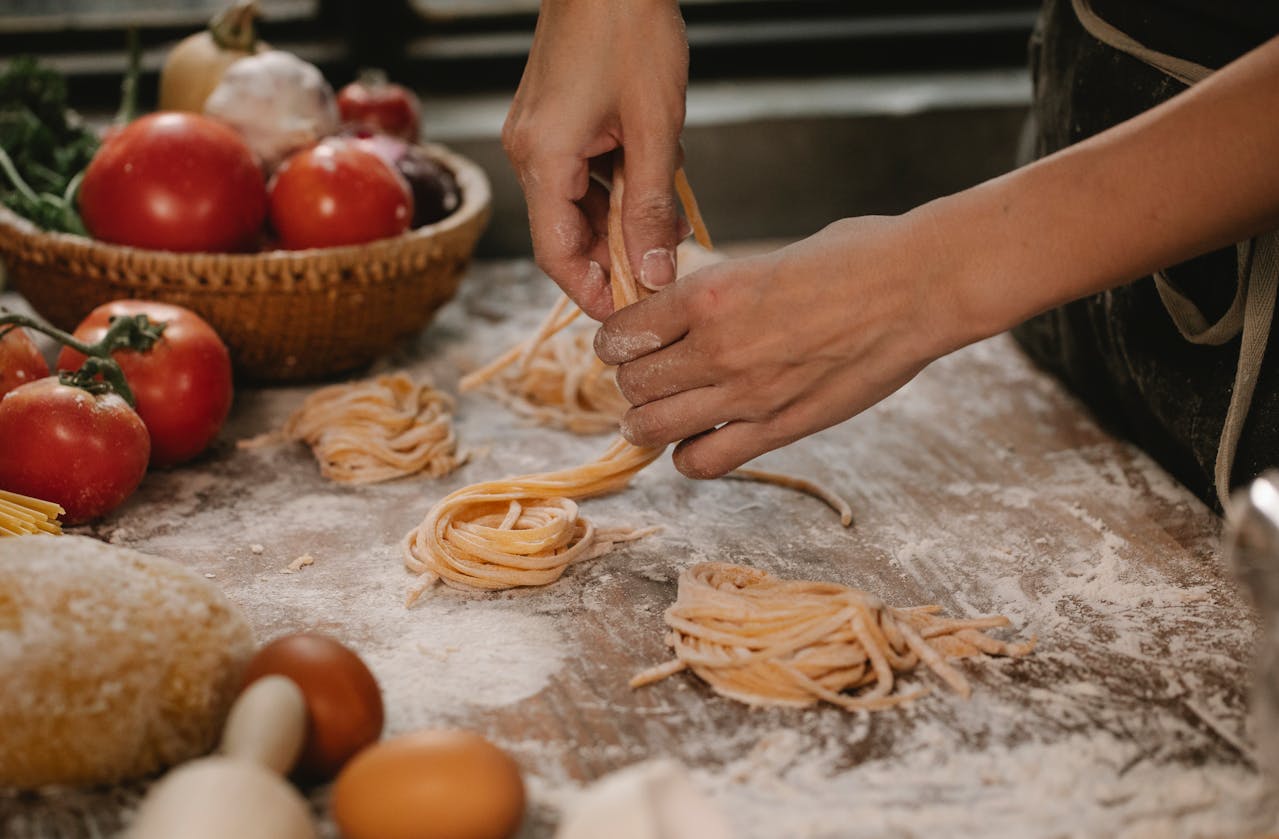
Mi piace cucinare. I like to cook.
Finally, let’s see some vocabulary for cooking in Italian related to specific ways of preparing different foods.
- Vado a cucinare la cena.
I’m going to cook dinner. - Questa è una ricetta facile / difficile.
This is an easy/hard recipe. - Devo comprare gli ingredienti.
I need to buy the ingredients. - Sto bollendo l’acqua.
I’m boiling water. - Sto cucinando riso / pasta / patate.
I’m cooking rice/pasta/potatoes. - Sto friggendo verdure / pollo / pesce.
I’m frying vegetables/chicken/fish. - Sto cuocendo pane / biscotti / una torta.
I’m baking bread/cookies/a cake. - Sto arrostendo agnello / pollo / manzo.
I’m roasting lamb/chicken/beef. - Sto grigliando pesce / pollo / verdure.
I’m grilling fish/chicken/vegetables. - Sto mescolando gli ingredienti.
I’m mixing the ingredients. - Sto mescolando la salsa.
I’m stirring the sauce. - Sto aggiungendo sale / zucchero / acqua / erbe / spezie.
I’m adding salt/sugar/water/herbs/spices.
Get on the road to speaking Italian with the Language Garage!
Buon Appetito! Enjoy your meal! We hope you’ve enjoyed learning how to talk about cooking in Italian. If you’d like to learn more:
- Follow us on Facebook, LinkedIn, BlueSky, Twitter, Threads, Mastodon, Instagram, or Pinterest. We publish lots of Italian vocabulary, grammar, and culture notes, so it’s a great way to pick up some new vocabulary and practice.
- Check out our other posts on Italian language, culture, and more.
- Enroll in affordable, flexible, and personalized private online Italian lessons or sign up for a small group online Italian class.
- Create a free Language Garage account to access tons of Italian vocabulary, grammar, and culture.
- Learn basic Italian with our self-study online Italian course.
Photo by Klaus Nielsen on Pexels